
IMViC Test
24th Mar 2026
IMViC Test: A Comprehensive Guide to Differential Identification of Enterobacteriaceae
Introduction to the IMViC Test
The IMViC Test is a classical biochemical testing series widely used in microbiology to differentiate members of the Enterobacteriaceae family. The acronym IMViC stands for:
- I – Indole Test
- M – Methyl Red Test
- V – Voges-Proskauer Test
- C – Citrate Utilization Test
This set of tests is essential for distinguishing closely related Gram-negative bacteria, particularly in clinical diagnostics, environmental microbiology, food safety, and water quality assessment.
Scientific Principle of the IMViC Test
The IMViC test evaluates metabolic differences among bacteria based on their ability to:
- Degrade tryptophan to indole
- Perform mixed acid fermentation
- Produce acetoin (butanediol pathway)
- Utilize citrate as a sole carbon source
These biochemical traits provide a metabolic fingerprint for bacterial identification.
1. Indole Test
Principle
The Indole Test determines the ability of bacteria to produce indole from the amino acid tryptophan via the enzyme tryptophanase.
Procedure
- Inoculate bacteria into tryptone broth
- Incubate at 35–37°C for 24–48 hours
- Add Kovac’s reagent
Results
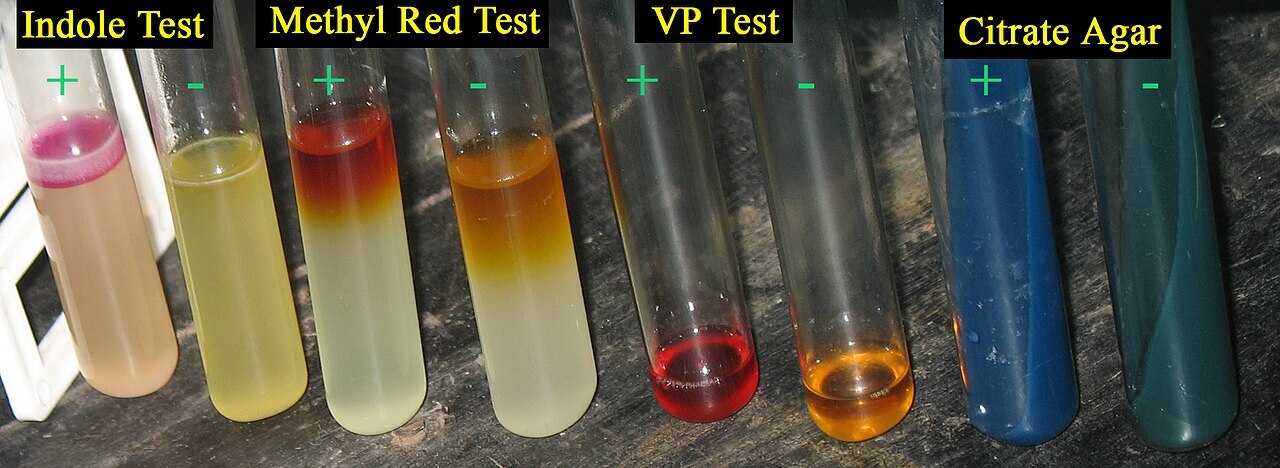
- Positive: Red ring (indole production)
- Negative: No color change
Significance
Commonly used to identify Escherichia coli, which is indole-positive.
2. Methyl Red Test
Principle
The Methyl Red Test detects stable acid production from glucose fermentation through the mixed acid pathway.
Procedure
- Inoculate MR-VP broth
- Incubate for 48 hours
- Add methyl red indicator
Results
- Positive: Red color (pH < 4.4)
- Negative: Yellow/orange
Significance
Indicates strong acid production, typical of E. coli and Proteus species.
3. Voges-Proskauer Test
Principle
The Voges-Proskauer Test identifies organisms that ferment glucose via the butanediol pathway, producing acetoin.
Procedure
- Use the same MR-VP broth
- Add Barritt’s reagents (α-naphthol and KOH)
- Shake and observe
Results
- Positive: Pink/red color
- Negative: No color change
Significance
Differentiates organisms like Enterobacter and Klebsiella (VP-positive) from E. coli (VP-negative).
4. Citrate Utilization Test
Principle
This test evaluates whether bacteria can use citrate as their sole carbon source and ammonium ions as a nitrogen source.
Procedure
- Inoculate Simmons citrate agar
- Incubate for 24–48 hours
Results
- Positive: Blue color (alkaline pH)
- Negative: Green (no growth)
Significance
Useful for identifying Enterobacter and Klebsiella, which are citrate-positive.
IMViC Test Results Interpretation
| Organism | Indole | Methyl Red | Voges-Proskauer | Citrate |
|---|---|---|---|---|
| Escherichia coli | + | + | – | – |
| Enterobacter spp. | – | – | + | + |
| Klebsiella spp. | – | – | + | + |
This pattern is often summarized as:
- E. coli: ++--
- Enterobacter/Klebsiella: --++
Applications of the IMViC Test
1. Clinical Microbiology
- Identification of pathogens in urinary tract infections (UTIs)
- Differentiation of coliform bacteria
2. Water Quality Testing
- Detection of fecal contamination via coliform analysis
3. Food Microbiology
- Monitoring hygiene and contamination in food production
4. Research Laboratories
- Studying metabolic diversity among bacteria
Advantages of the IMViC Test
- Cost-effective and easy to perform
- Reliable for differentiating enteric bacteria
- Widely standardized in microbiology labs
Limitations of the IMViC Test
- Time-consuming (requires incubation)
- Not sufficient alone for complete identification
- Requires complementary tests (e.g., oxidase, urease, molecular assays)
Modern Alternatives and Complementary Techniques
While the IMViC Test remains foundational, modern microbiology increasingly incorporates:
- PCR-based identification
- Next-Generation Sequencing (NGS)
- MALDI-TOF mass spectrometry
These methods provide faster and more precise microbial identification but are often used alongside traditional biochemical tests.
Conclusion
The IMViC Test is a cornerstone in microbiological diagnostics, offering a simple yet powerful approach to differentiate members of the Enterobacteriaceae family. Despite advancements in molecular techniques, it remains an essential tool in laboratories worldwide due to its reliability, accessibility, and educational value.