
What Are Volumetric Pipettes Used For?
What Are Volumetric Pipettes Used For?
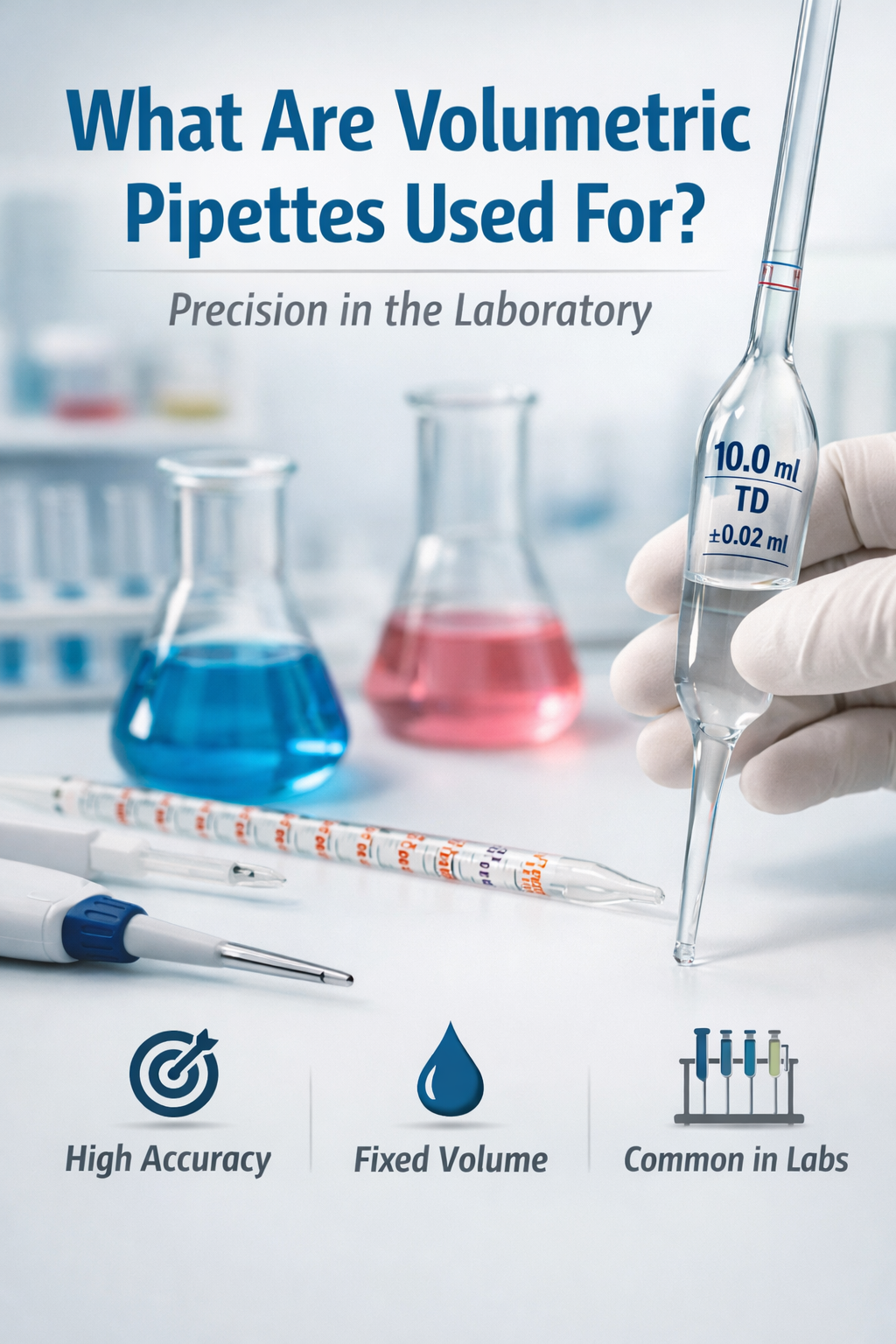
What is a pipette?
A pipette is a common laboratory instrument used to transfer and dispense precise quantities of liquids. There are many types of pipettes, each with its own specific features in terms of use, design, and operation. Among the most commonly used are volumetric and graduated pipettes, found in most laboratories and research centers. However, important differences distinguish them, and each type has its own advantages and disadvantages. It is therefore essential to fully understand how each works before using it.
Both instruments are designed to transfer small, measurable quantities of liquid solutions. However, they differ in precision, graduations, and capacity. In general, graduated pipettes allow the transfer of varying liquid volumes, while a volumetric pipette is designed to deliver only a single, fixed volume of solution.
Types of pipettes
Pipettes can be made of glass or plastic and are used to transfer measurable amounts of liquid.
They are designed either to contain (TC – “to contain”) or to deliver (TD – “to deliver”) a specific volume, according to the manufacturer’s specifications. TC pipettes hold an exact volume but do not deliver it precisely, whereas TD pipettes deliver the exact calibrated volume.
Volumetric pipettes
Volumetric pipettes (also called bulb pipettes) are slender, highly calibrated instruments designed for extreme precision. They are commonly used in chemical analysis and in the study of chemical and biological properties. Their main advantage lies in their ability to deliver a precise volume of liquid with accuracy up to four significant figures, making them ideal for precise measurements.
The main advantage of a volumetric pipette is its precision. It is especially accurate for solution preparation and titration, largely due to its narrow neck, which is a key feature of its standard design. This allows for a more precise reading of the meniscus and, therefore, more accurate results compared to a graduated pipette.
Standard volumetric pipettes are available in fixed sizes ranging from 1 mL to 50 mL, including common volumes such as 10 mL and 25 mL. Variable-volume pipettes also exist; these feature an adjustment system that simplifies and speeds up the selection of precise volumes. They use a digital stop mechanism, come in various sizes, and are easy to calibrate and maintain.
Key characteristics of volumetric pipettes
Advantages:
- Extremely precise
- Easy to read (reduces the risk of human error)
- Available in different fixed sizes
- Variable-volume pipettes improve both accuracy and ease of use
Disadvantages:
- Can be more expensive
- Fixed dimensions specific to each pipette; performing different laboratory procedures requiring various volumes may require multiple volumetric pipettes