
Biosafety Cabinets
13th Apr 2026
Biosafety Cabinets: Definition, Classes (I, II, III) and Types
Introduction
Biosafety cabinets (BSCs) are essential laboratory equipment designed to provide personnel, environmental, and product protection when working with hazardous biological materials. They are widely used in microbiology, molecular biology, pharmaceutical, and clinical laboratories.
Understanding the different classes and types of biosafety cabinets is crucial for selecting the right system and ensuring laboratory safety.
Definition of Biosafety Cabinets
A biosafety cabinet is a ventilated enclosure that uses HEPA (High-Efficiency Particulate Air) filtration to contain infectious agents and protect:
- The user (personnel protection)
- The sample (product protection)
- The environment (environmental protection)
BSCs are different from laminar flow hoods because they are specifically designed for biohazard containment.
Key Components of a Biosafety Cabinet
- HEPA Filters – Remove ≥99.97% of particles ≥0.3 µm
- Airflow System – Controls directional airflow
- Work Surface – Sterile working area
- Front Opening (Sash) – Access point for handling materials
- Exhaust System – Removes contaminated air
Classes of Biosafety Cabinets
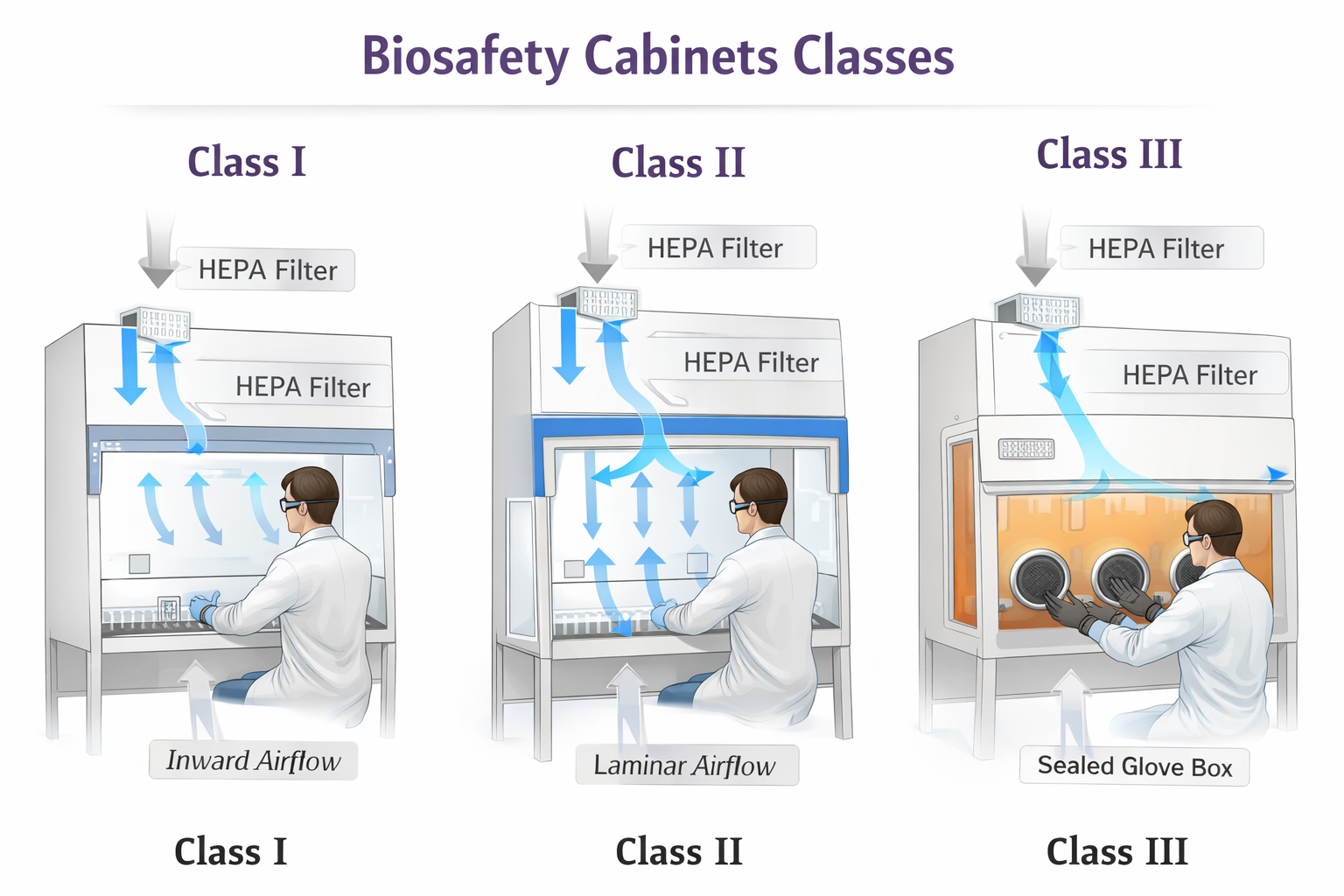
Biosafety cabinets are classified into Class I, Class II, and Class III, based on the level of protection they provide.
Class I Biosafety Cabinet
Overview
Class I cabinets provide personnel and environmental protection, but no product protection.
Features
- Inward airflow from the room
- HEPA-filtered exhaust air
- No protection for samples
Applications
- Basic microbiological work
- Handling low to moderate risk agents
Class II Biosafety Cabinet
Overview
Class II cabinets are the most commonly used and provide:
- Personnel protection
- Product protection
- Environmental protection
Airflow System
- Vertical laminar airflow
- HEPA-filtered supply and exhaust
Types of Class II Cabinets
Type A1
- Recirculates ~70% of air
- Exhausts ~30%
- Suitable for low-risk work
Type A2
- Similar to A1 but with higher safety standards
- Most widely used in labs
Type B1
- Partial exhaust to outside
- Suitable for work with small amounts of chemicals
Type B2
- 100% exhaust (no recirculation)
- Used with hazardous chemicals and biological agents
Class III Biosafety Cabinet
Overview
Class III cabinets offer the highest level of protection.
Features
- Gas-tight, sealed enclosure
- Operated using glove ports
- HEPA-filtered air supply and exhaust
- Negative pressure environment
Applications
- High-risk pathogens
- Work in BSL-4 laboratories
Comparison of Biosafety Cabinet Classes
| Feature | Class I | Class II | Class III |
|---|---|---|---|
| Personnel Protection | ✅ | ✅ | ✅ |
| Product Protection | ❌ | ✅ | ✅ |
| Environmental Protection | ✅ | ✅ | ✅ |
| Airflow Type | Inward | Laminar | Sealed |
| Risk Level | Low Moderate | Moderate High | Very High |
Types of Biosafety Cabinets (Summary)
- Class I → Basic protection
- Class II (A1, A2, B1, B2) → Most common, versatile
- Class III → Maximum containment
Applications of Biosafety Cabinets
Biosafety cabinets are used in:
- Clinical diagnostics
- Vaccine production
- Pharmaceutical research
- Microbiology laboratories
- Genetic engineering
Advantages of Biosafety Cabinets
- Protect users from biohazards
- Maintain sterile working conditions
- Prevent environmental contamination
- Essential for regulatory compliance
Limitations
- Require regular maintenance and certification
- Expensive compared to standard hoods
- Improper use reduces effectiveness
Conclusion
Biosafety cabinets are critical for maintaining laboratory safety and contamination control. Understanding the differences between Class I, II, and III cabinets, as well as their specific types, allows laboratories to choose the appropriate equipment for their needs.
For most laboratories, Class II biosafety cabinets (especially Type A2) provide the best balance between safety and functionality.