
Chromosome vs Chromatid: Key Differences Explained
17th Apr 2026
Chromosome vs Chromatid : Key Differences Explained
Introduction
In cell biology, the terms chromosome and chromatid are often used interchangeably, but they refer to distinct structural states of genetic material. Understanding the difference between a chromosome and a chromatid is essential for grasping processes like cell division, DNA replication, and genetic inheritance.
What is a Chromosome?
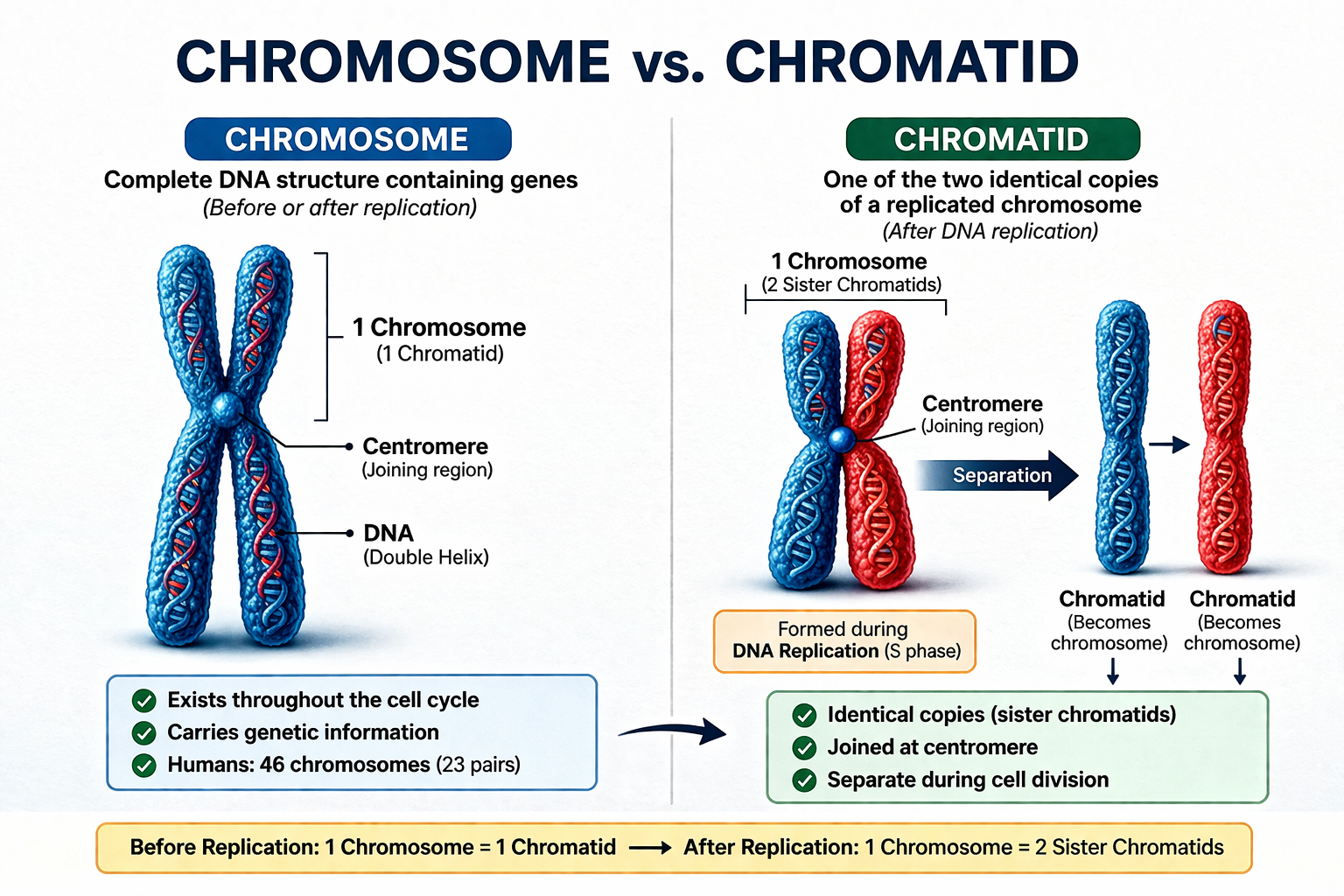
A chromosome is a long, organized structure of DNA and associated proteins (histones) that carries genetic information.
Key Features:
- Found in the nucleus of eukaryotic cells
- Contains genes arranged linearly
- Can exist in two forms:
- Unreplicated (single chromatid)
- Replicated (two sister chromatids)
Humans typically have 46 chromosomes (23 pairs).
What is a Chromatid?
A chromatid is one of the two identical copies of a replicated chromosome.
Key Features:
- Formed during DNA replication (S phase)
- Two sister chromatids are joined at a centromere
- Each chromatid contains an identical DNA sequence
When sister chromatids separate during cell division, they become individual chromosomes.
Chromosome vs Chromatid : Main Differences
| Feature | Chromosome | Chromatid |
|---|---|---|
| Definition | Complete DNA structure | One copy of a duplicated chromosome |
| Structure | One or two chromatids | Single DNA molecule |
| Occurrence | Throughout the cell cycle | Only after DNA replication |
| Function | Stores genetic information | Ensures accurate DNA distribution |
| During division | Splits into chromatids | Separates into chromosomes |
Relationship Between Chromosome and Chromatid
- Before replication → chromosome = 1 chromatid
- After replication → chromosome = 2 sister chromatids
- During mitosis/meiosis → chromatids separate → become chromosomes
Role in Cell Division
Mitosis
- Sister chromatids separate
- Each daughter cell receives identical chromosomes
Meiosis
- Homologous chromosomes separate first
- Then sister chromatids separate
- Leads to genetic diversity
Why This Difference Matters
Understanding chromosomes vs chromatids is crucial in:
- Genetics and inheritance
- Cancer research (abnormal chromosome division)
- Biotechnology and genomics
- Clinical diagnostics (karyotyping)
Conclusion
A chromosome is the complete structure carrying genetic material, while a chromatid is one of its identical copies formed during replication. Though closely related, distinguishing between them is essential for understanding how cells divide and pass genetic information accurately.