
Pathology Scanner Advancing Digital Histopathology for Modern Diagnostics
4th Dec 2025
Pathology Scanner : Advancing Digital Histopathology for Modern Diagnostics
this blog is intended for educational and scientific purposes only. All trademarks and product names mentioned, including VENTANA, are the property of their respective owners and are used solely for descriptive purposes.
Introduction
Digital pathology has revolutionized the field of histopathology by enabling laboratories to convert glass slides into high-resolution digital images. At the core of this transformation lies the pathology scanner, a device capable of producing precise whole-slide images that facilitate accurate diagnosis, remote consultation, and quantitative image analysis. Among the leading solutions in this domain are the VENTANA whole slide scanners, including the DP 200 and DP 600 systems, which combine high-quality imaging with workflow efficiency and reliability.

Understanding the Role of Pathology Scanners
A pathology scanner is designed to digitize histological slides at high resolution, producing images suitable for both qualitative assessment and computational analysis. This technology enables:
-
Enhanced diagnostic precision: Digital slides allow pathologists to detect subtle histopathological features that might be missed under traditional microscopy.
-
Remote collaboration: Whole-slide images can be securely shared with specialists worldwide, supporting telepathology and multidisciplinary review.
-
Quantitative analysis: Digital images can be analyzed with image analysis algorithms or AI-based tools to quantify staining intensity, cell counts, or morphological features.
By transforming analog slides into digital datasets, pathology scanners bridge the gap between traditional histology and modern computational pathology.
VENTANA Whole Slide Scanners: DP 200 vs DP 600
VENTANA pathology scanners are engineered for high-resolution imaging, accurate color reproduction, and reliable workflow integration.
VENTANA DP 200
-
Ideal for urgent cases or remote sites
-
Small footprint for space-limited labs
-
Supports 20x and 40x magnification
-
Automated scanning and digitization for consistent results
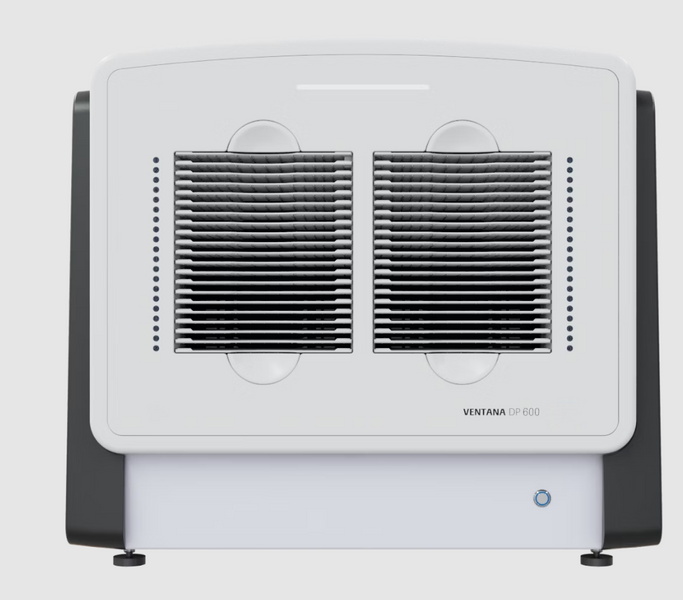
VENTANA DP 600
-
High-capacity system, supporting up to 240 slides
-
Optimized for central labs with large volumes
-
Automated calibration ensures minimal rescan rates
-
Fully compatible with digital pathology networks and AI-based analysis
Both scanners are designed to complement each other in large laboratories, providing flexibility for routine and STAT workflows.
Scientific Advantages of Using a Pathology Scanner
1. Standardization and Reproducibility
Pathology scanners produce consistent digital images with accurate color and focus, reducing observer variability and ensuring reproducible results across studies.
2. Integration with Computational Pathology
Digitized slides can be analyzed with AI algorithms to detect biomarkers, quantify cellular features, and support predictive diagnostics. This integration enhances research capabilities and clinical decision-making.
3. Scalability and Workflow Efficiency
High-throughput scanners like the VENTANA DP 600 enable laboratories to process increasing numbers of slides without compromising speed or image quality. Automation reduces manual handling errors and supports laboratory accreditation standards.
4. Facilitating Education and Training
Digital slides can be archived and used for training pathology residents, supporting virtual microscopy and remote learning initiatives without the need for physical slides.
Applications in Modern Research and Clinical Diagnostics
Pathology scanners are not only used for routine histopathology but also for advanced research and translational studies:
-
Cancer research: High-resolution images allow detailed evaluation of tumor architecture and immunohistochemical staining.
-
Clinical trials: Digital slides enable centralized review, standardization, and quantitative analysis across multiple sites.
-
Infectious disease studies: Histological changes and pathogen localization can be analyzed with greater precision.
-
Biomarker discovery: Integration with image analysis and AI facilitates identification of novel diagnostic or prognostic markers.
By digitizing slides and integrating them into computational workflows, pathology scanners accelerate both research and clinical decision-making.
Conclusion
The pathology scanner is a cornerstone of digital pathology, offering high-resolution imaging, reproducibility, and integration with modern computational tools. Systems such as the VENTANA DP 200 and DP 600 enable laboratories to scale digital workflows, improve diagnostic accuracy, and support research innovation. As digital and computational pathology continues to advance, pathology scanners will play an increasingly central role in precision medicine, translational research, and global collaboration in healthcare.