
Plasmid DNA Purification
23rd Mar 2026
Plasmid DNA Purification: Principles, Methods, and Advanced Applications
Introduction
Plasmid DNA purification is a fundamental technique in molecular biology, enabling the isolation of high-quality plasmid DNA from bacterial cultures for downstream applications such as cloning, sequencing, transfection, and gene expression studies. With the increasing demand for precision in genomics, biotechnology, and synthetic biology, optimizing plasmid purification workflows has become essential for both research and industrial laboratories.
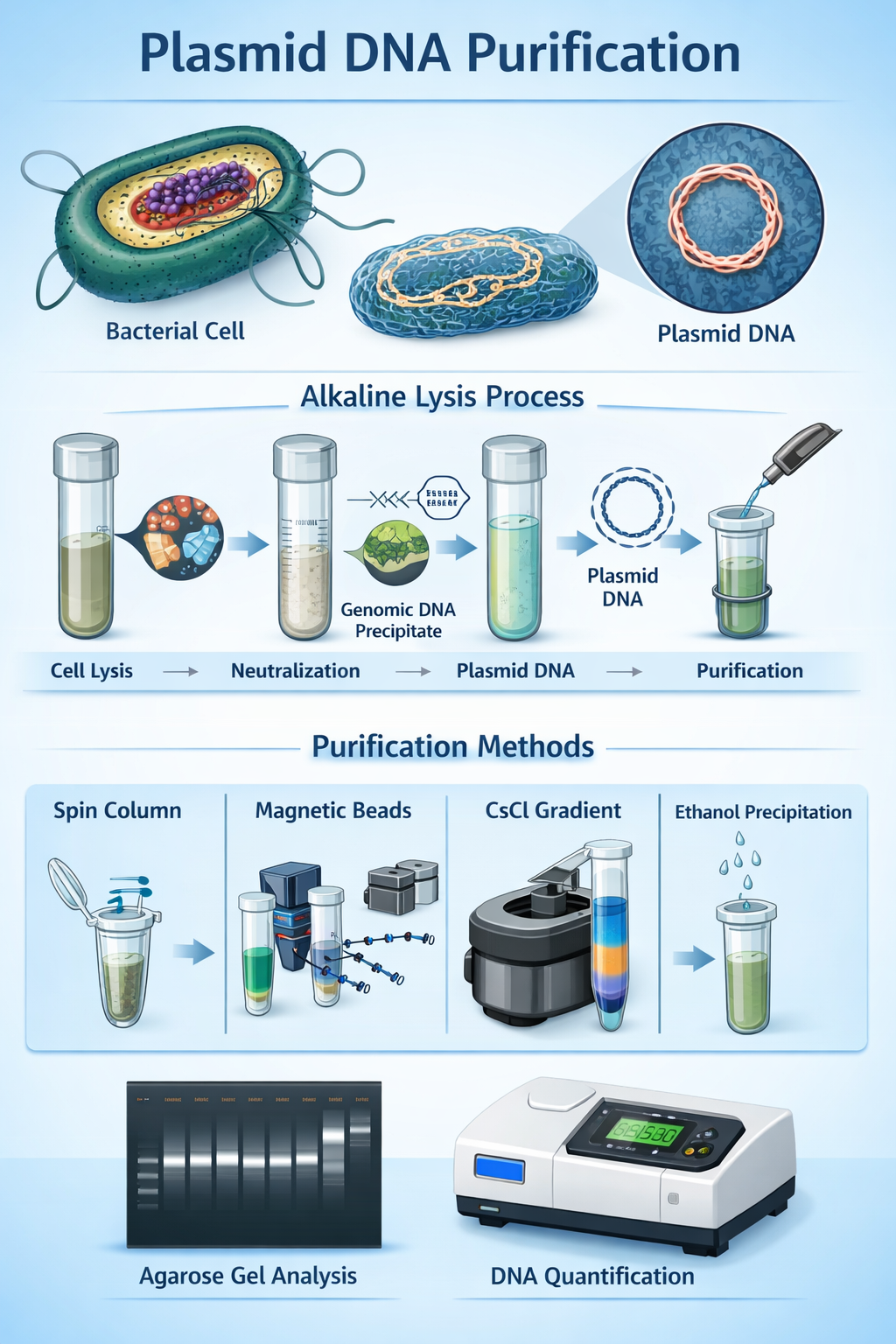
What is Plasmid DNA?
Plasmids are small, circular, double-stranded DNA molecules that exist independently of chromosomal DNA in bacteria and some eukaryotic cells. They are widely used as vectors in genetic engineering because they can replicate autonomously and carry foreign genes.
Core Principles of Plasmid DNA Purification
The goal of plasmid DNA purification is to selectively isolate plasmid DNA while removing:
- Genomic DNA
- RNA
- Proteins
- Lipids and cellular debris
The most widely used principle is alkaline lysis, which exploits the differential denaturation and renaturation properties of plasmid and chromosomal DNA.
Key Steps:
- Cell Lysis
Bacterial cells are lysed using an alkaline solution containing sodium hydroxide (NaOH) and detergents (e.g., SDS). - Denaturation
Both chromosomal and plasmid DNA are denatured under alkaline conditions. - Neutralization
Addition of potassium acetate allows plasmid DNA to renature correctly, while chromosomal DNA precipitates. - Separation
Centrifugation removes precipitated debris, leaving plasmid DNA in the supernatant. - Purification
DNA is further purified using silica columns, magnetic beads, or precipitation methods.
Common Methods for Plasmid DNA Purification
1. Spin Column-Based Purification
This is the most widely used technique in modern labs.
Principle:
DNA binds to silica membranes in the presence of chaotropic salts.
Advantages:
- High purity
- Fast and reproducible
- Suitable for automation
Limitations:
- Cost per sample
- Limited binding capacity
2. Magnetic Bead-Based Purification
Magnetic beads coated with DNA-binding surfaces allow efficient purification.
Advantages:
- Scalable and automation-friendly
- No centrifugation required
- Ideal for high-throughput workflows
Applications:
- NGS workflows
- Robotic liquid handling systems
3. Cesium Chloride (CsCl) Gradient Ultracentrifugation
A classical method used for ultra-pure plasmid preparation.
Advantages:
- Extremely high purity
- Suitable for sensitive applications (e.g., gene therapy)
Limitations:
- Time-consuming
- Requires specialized equipment
4. Precipitation-Based Methods
Ethanol or isopropanol precipitation is used for DNA recovery.
Advantages:
- Low cost
- Simple protocol
Limitations:
- Lower purity
- Risk of salt contamination
Factors Affecting Plasmid DNA Quality
To achieve optimal results in plasmid DNA purification, several factors must be controlled:
- Bacterial strain: High-copy plasmids yield more DNA
- Growth conditions: Overgrowth can reduce plasmid quality
- Lysis efficiency: Incomplete lysis lowers yield
- RNase treatment: Essential to remove RNA contamination
- Elution buffer composition: Impacts DNA stability
Quality Control of Purified Plasmid DNA
1. Spectrophotometry
- A260/A280 ratio (~1.8 indicates pure DNA)
- A260/A230 ratio (>2.0 preferred)
2. Agarose Gel Electrophoresis
- Confirms DNA integrity and size
- Detects contamination or degradation
3. Fluorometric Quantification
- More accurate for low concentrations
Applications of Plasmid DNA Purification
High-quality plasmid DNA is essential for:
- Molecular cloning
- PCR amplification
- DNA sequencing
- Gene expression studies
- CRISPR/Cas9 genome editing
- Transfection into mammalian cells
- Vaccine development and gene therapy
Advanced Trends in Plasmid DNA Purification
1. Endotoxin-Free Plasmid Preparation
Critical for transfection and therapeutic applications, especially in mammalian systems.
2. Automation and High-Throughput Systems
Integration with robotic platforms for large-scale plasmid extraction.
3. GMP-Grade Plasmid Production
Required for clinical applications such as DNA vaccines and gene therapies.
4. Nanotechnology-Based Purification
Emerging methods using nanomaterials for higher specificity and efficiency.
Optimization Tips for Better Results
- Use fresh bacterial cultures in the logarithmic growth phase
- Avoid vigorous mixing during lysis to prevent genomic DNA shearing
- Ensure complete resuspension of cell pellets
- Use endotoxin-free reagents when needed
- Optimize elution volume for concentration vs. yield
Conclusion
Plasmid DNA purification remains a cornerstone technique in molecular biology and biotechnology. With advancements in purification technologies, researchers can now achieve higher yields, improved purity, and scalability for a wide range of applications from routine cloning to cutting-edge gene therapy. Selecting the appropriate method and optimizing each step of the workflow are critical to ensuring reliable and reproducible results.
Scientific References
- Birnboim, H. C., & Doly, J. (1979). A rapid alkaline extraction procedure for screening recombinant plasmid DNA. Nucleic Acids Research.
- Sambrook, J., & Russell, D. W. (2001). Molecular Cloning: A Laboratory Manual. Cold Spring Harbor Laboratory Press.
- Green, M. R., & Sambrook, J. (2017). Isolation of plasmid DNA using alkaline lysis method. Cold Spring Harbor Protocols.
- Qiagen Technical Handbook: Plasmid DNA Purification.
- Tan, S. C., & Yiap, B. C. (2009). DNA, RNA, and protein extraction: the past and the present. Journal of Biomedicine and Biotechnology.