
Protein Synthesis in Eukaryotes: Definition, Enzymes, and Process
17th Apr 2026
Protein Synthesis in Eukaryotes: Definition, Enzymes, and Process
Introduction
Protein synthesis in eukaryotes is a highly regulated and complex biological process through which cells produce proteins essential for structure, function, and regulation. This process involves two major stages: transcription and translation, occurring in different cellular compartments.
Understanding protein synthesis in eukaryotes is fundamental in molecular biology, biotechnology, and medical research, especially in areas such as gene expression, genetic disorders, and drug development.
Definition of Protein Synthesis in Eukaryotes
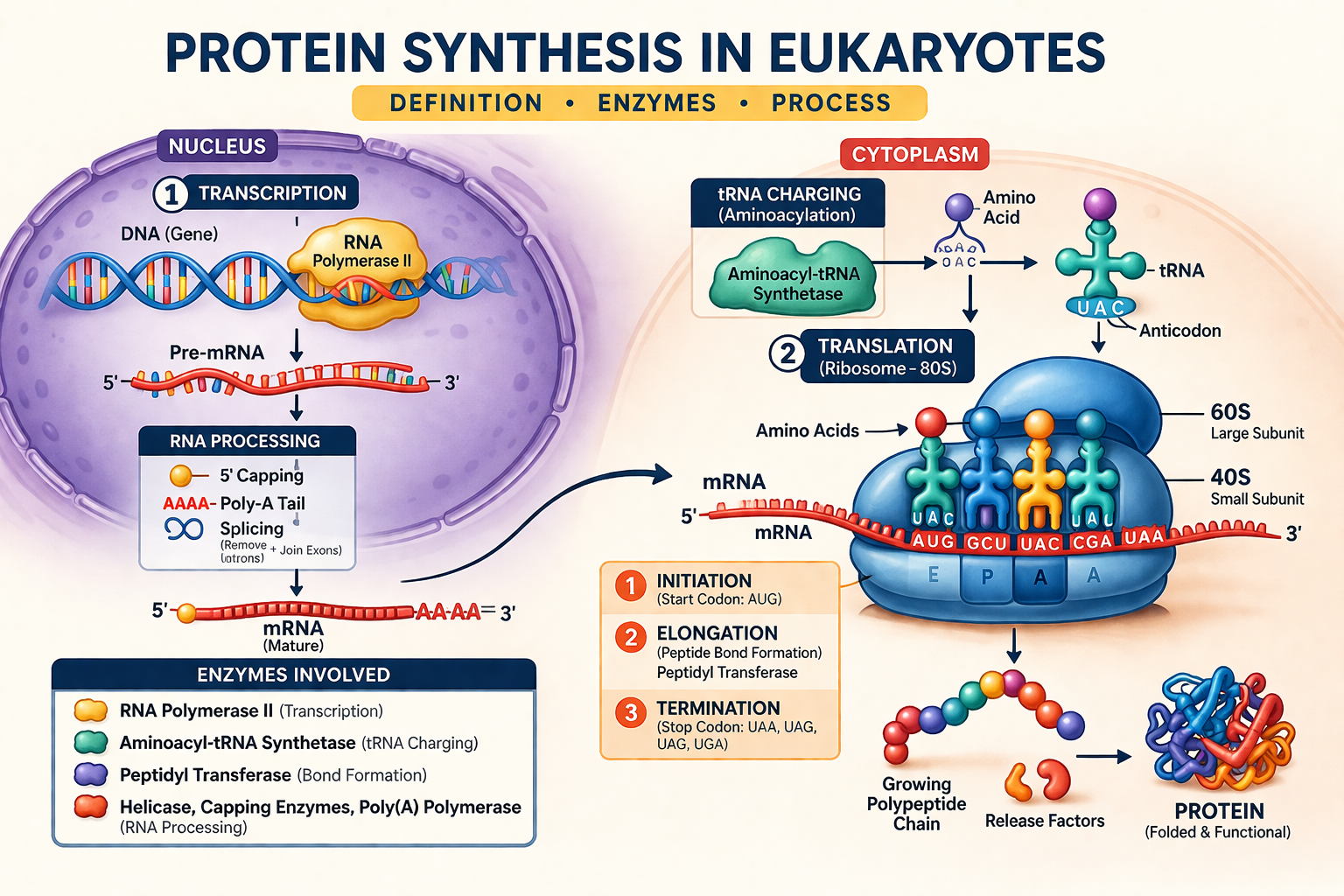
Protein synthesis in eukaryotes is the process by which genetic information encoded in DNA is transcribed into messenger RNA (mRNA) in the nucleus and then translated into a functional protein in the cytoplasm.
Key Components Involved
1. Nucleic Acids
- DNA: Contains genetic instructions
- mRNA: Carries genetic code to ribosomes
- tRNA: Transfers amino acids
- rRNA: Structural and catalytic component of ribosomes
2. Ribosomes
- Located in the cytoplasm or attached to the rough endoplasmic reticulum
- Composed of a 40S (small) and 60S (large) subunit forming an 80S ribosome
3. Amino Acids
- Building blocks of proteins
- Linked by peptide bonds to form polypeptides
Enzymes Involved in Protein Synthesis
Several enzymes and factors ensure accurate and efficient protein production:
1. RNA Polymerase II
- Synthesizes mRNA from DNA during transcription
2. Aminoacyl-tRNA Synthetase
- Attaches specific amino acids to their corresponding tRNA
3. Peptidyl Transferase
- Catalyzes peptide bond formation during translation
4. Helicase
- Unwinds DNA during transcription
5. Capping and Polyadenylation Enzymes
- Modify mRNA (5’ cap and poly-A tail) for stability and transport
Stages of Protein Synthesis in Eukaryotes
1. Transcription (Nucleus)
Steps:
Initiation
- RNA polymerase binds to the promoter region of DNA
- DNA unwinds
Elongation
- mRNA strand is synthesized in the 5’ → 3’ direction
Termination
- Transcription stops at a termination sequence
Post-Transcriptional Modifications
- 5’ capping: Protects mRNA
- Poly-A tail addition: Enhances stability
- Splicing: Removes introns and joins exons
2. Translation (Cytoplasm)
Translation occurs on ribosomes and converts mRNA into a protein.
Steps:
Initiation
- Ribosome binds to mRNA
- Start codon (AUG) is recognized
- Initiator tRNA carrying methionine binds
Elongation
- tRNA brings amino acids according to codons
- Peptide bonds form between amino acids
- Ribosome moves along mRNA
Termination
- Stop codon (UAA, UAG, UGA) is reached
- Release factors free the completed polypeptide
3. Post-Translational Modifications
After translation, proteins undergo modifications:
- Folding (via chaperone proteins)
- Phosphorylation
- Glycosylation
- Cleavage of signal peptides
These modifications are essential for protein functionality.
Differences Between Eukaryotic and Prokaryotic Protein Synthesis
| Feature | Eukaryotes | Prokaryotes |
|---|---|---|
| Location | Nucleus & Cytoplasm | Cytoplasm only |
| mRNA processing | Extensive | Minimal |
| Ribosome size | 80S | 70S |
| Transcription/Translation | Separate | Coupled |
Importance of Protein Synthesis
- Essential for cell growth and repair
- Regulates metabolic pathways
- Plays a role in immune responses
- Target for many antibiotics and drugs
Applications in Biotechnology and Medicine
- Recombinant protein production
- Gene therapy
- Vaccine development
- Cancer research
Conclusion
Protein synthesis in eukaryotes is a finely tuned, multi-step process critical for life. From DNA transcription in the nucleus to protein assembly in the cytoplasm, each step is tightly regulated to ensure accuracy and efficiency.
Advancements in molecular biology continue to uncover new aspects of this process, opening doors to innovative therapies and biotechnological applications.