
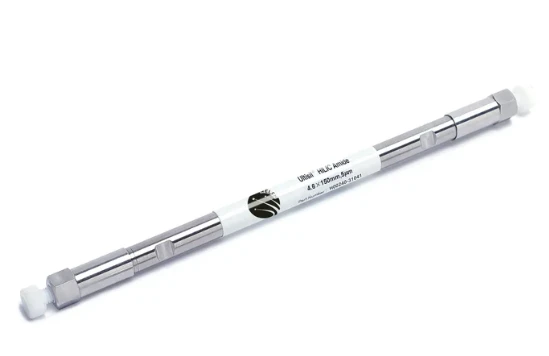
HPLC Column: Ultisil HILIC Amide, 5 μm, 4.6 × 250 mm
30th Oct 2026
HPLC Chromatography Columns
HPLC Column: Ultisil HILIC Amide, 5 μm, 4.6 × 250 mm
Amide-based hydrophilic interaction chromatography column designed for efficient separation of polar compounds, sugars, peptides, and low-molecular-weight pharmaceuticals.

Ultisil HILIC Amide HPLC Column
Product Information
| Catalog Number | 1686-H00240-31043 |
| Brand | Ultisil |
| Particle Size | 5 μm |
| Dimensions | 4.6 × 250 mm |
| Pore Size | 120 Å |
| Bonding Phase | HILIC Amide |
| Dry Ice | No |
| Hazardous | No |
Availability & Ordering
24/48H Stock Items & 2 to 6 Weeks non Stock Items.
Login for PriceContact our team for product information and purchasing assistance.
Send RequestProduct Description
The Ultisil HILIC Amide HPLC Column is an amide-based hydrophilic interaction liquid chromatography (HILIC) column manufactured using ultra-pure spherical silica. It is designed for the separation and analysis of highly polar and hydrophilic compounds that can be challenging to retain using conventional reversed-phase chromatography.
With a 5 μm particle size, 4.6 mm internal diameter, and 250 mm column length, this stationary phase provides an effective separation platform for sugars, peptides, and low-molecular-weight polar pharmaceutical compounds.
The amide bonding chemistry provides selectivity similar to HILIC-NH2 phases, while offering different separation characteristics. Its chromatographic properties make it useful for analytical method development and routine analysis of polar substances.
The column also offers low baseline drift in applications using evaporative light scattering detection (ELSD) and mass spectrometry (MS), supporting reliable chromatographic analysis.
Key Features and Benefits
- Amide-Based HILIC Chemistry: Provides selective retention and separation of polar and hydrophilic compounds.
- Ultra-Pure Silica: Manufactured using spherical porous silica with a purity greater than 99.999%.
- High Column Efficiency: Theoretical plate number greater than 80,000 plates/meter.
- Excellent Peak Symmetry: Tailing factor of approximately 0.95–1.05 under specified test conditions.
- Wide pH Compatibility: Recommended pH operating range of 2.0–8.0.
- Reproducible Performance: Designed for excellent lot-to-lot consistency.
- Detection Compatibility: Suitable for HILIC applications involving ELSD and MS detection.
Applications of Ultisil HILIC Amide Columns
HILIC chromatography is particularly useful for compounds that are highly polar and show limited retention in conventional reversed-phase HPLC. The Ultisil HILIC Amide stationary phase can be used in analytical workflows involving:
- Sugar Analysis: Separation of carbohydrates and other hydrophilic sugar compounds.
- Peptide Analysis: Chromatographic separation of polar peptides.
- Pharmaceutical Analysis: Analysis of low-molecular-weight polar pharmaceutical substances.
- Polar Metabolite Analysis: Separation of hydrophilic compounds in complex biological and chemical samples.
- Analytical Method Development: Development and optimization of HILIC separation methods.
- Mass Spectrometry Workflows: Separation of polar analytes before MS detection.
Technical Specifications
| Parameter | Specification |
|---|---|
| Product Series | Ultisil HILIC |
| Bonding Phase | Amide |
| Particle Size | 5 μm |
| Column Inner Diameter | 4.6 mm |
| Column Length | 250 mm |
| Pore Size | 120 Å |
| Silica Purity | Greater than 99.999% |
| Recommended pH Range | 2.0–8.0 |
| Theoretical Plate Number | Greater than 80,000 plates/meter |
| Tailing Factor | 0.95–1.05 |
| Catalog Number | 1686-H00240-31043 |
Ultisil HPLC Column Packing Material Quality
Ultisil HPLC columns are based on ultra-pure spherical and totally porous silica particles, combined with specialized bonding chemistry and surface modification techniques.
These manufacturing characteristics contribute to:
- Consistent chromatographic selectivity.
- Improved peak shape and column efficiency.
- Reduced unwanted interactions between analytes and the silica surface.
- Reliable reproducibility between manufacturing batches.
- Flexible stationary-phase options for analytical method development.
Trace Metal Content Evaluation in Silica-Based Columns
Trace metal impurities in silica can influence chromatographic performance, particularly for analytes capable of interacting with metal ions. One approach to evaluating metal-related surface interactions is to compare the peak symmetry of positional isomers and chelating compounds.
A commonly described test uses 4,4'-dipyridyl as a reference compound, alongside 2,2'-dipyridyl and 1,2-dihydroxynaphthalene. The latter compounds can interact with trace metals, potentially producing peak tailing or changes in peak shape when metal contamination is present.
This type of evaluation helps characterize silica-based stationary phases and their chromatographic behavior.
Example Chromatographic Test Conditions
| Test Column | Ultisil XB-C18, 4.6 × 150 mm, 5 μm |
| Mobile Phase | 20 mM phosphate (pH 7.6) / methanol = 55/45 |
| Flow Rate | 1.0 mL/min |
| Detector | 215 nm |
| Temperature | 25 °C |
| Injection Volume | 1 μL |
| Test Compounds | 4,4'-Dipyridyl, 2,2'-Dipyridyl, 1,2-Dihydroxynaphthalene |
Note: These are example test conditions for silica-based column evaluation, not operating conditions specifically validated for the HILIC Amide column.
Related Ultisil HILIC Columns
Other Ultisil HILIC stationary phases and particle sizes are available for different chromatographic selectivity and separation requirements.
| Catalog | Product |
|---|---|
| H00240-21043 | Ultisil HILIC Amide, 3 μm, 4.6 × 250 mm |
| H00240-41043 | Ultisil HILIC Amide, 10 μm, 4.6 × 250 mm |
| H00240-20043 | Ultisil HILIC Amide, 3.5 μm, 4.6 × 250 mm |
| H00231-31043 | Ultisil HILIC-NH2, 5 μm, 4.6 × 250 mm |
| H00242-31043 | Ultisil HILIC Diol, 5 μm, 4.6 × 250 mm |
| H00228-31043 | Ultisil HILIC Silica, 5 μm, 4.6 × 250 mm |
| H00228-21043 | Ultisil HILIC Silica, 3 μm, 4.6 × 250 mm |
| H00231-21043 | Ultisil HILIC-NH2, 3 μm, 4.6 × 250 mm |
| H00274-31043 | Ultisil HILIC Amphion, 5 μm, 4.6 × 250 mm II |
| H00240-31039 | Ultisil HILIC Amide, 5 μm, 4.6 × 100 mm |
Frequently Asked Questions
1. What is an Ultisil HILIC Amide column used for?
It is used for hydrophilic interaction liquid chromatography and the separation of polar compounds, including sugars, peptides, and low-molecular-weight pharmaceuticals.
2. What does HILIC mean in chromatography?
HILIC stands for Hydrophilic Interaction Liquid Chromatography. It is a chromatographic technique used to retain and separate highly polar compounds, often using a polar stationary phase and a mobile phase rich in organic solvent.
3. What is the advantage of an amide stationary phase?
An amide-based stationary phase provides specific selectivity for polar analytes and offers separation characteristics that differ from other HILIC phases, including amino and silica-based columns.
4. What does the 5 μm particle size indicate?
The 5 μm value represents the average stationary-phase particle size. Particle size influences column efficiency, pressure requirements, and chromatographic separation performance.
5. What is the recommended pH range?
The specified operating pH range for this Ultisil silica-based column series is 2.0–8.0. Always consider the mobile phase and method conditions when selecting an operating pH.
6. Can this column be used with mass spectrometry?
Yes. HILIC separation is commonly used before mass spectrometry for polar analytes. Mobile-phase composition and additives should be selected according to MS compatibility and analytical requirements.
Optimize Your HILIC Chromatography Separations
Explore the Ultisil HILIC Amide HPLC Column (1686-H00240-31043), featuring 5 μm particles and a 4.6 × 250 mm format for the analysis of polar compounds.
Login for PriceContact our team for technical questions and ordering assistance.