
MacConkey Agar Composition
13th Apr 2026
MacConkey Agar Composition: Complete Guide for Microbiology Labs
Introduction
MacConkey agar composition is a fundamental topic in microbiology, especially for laboratories working with bacterial isolation and identification. This selective and differential culture medium is widely used to isolate Gram-negative bacteria and differentiate them based on lactose fermentation.
Understanding the composition of MacConkey agar helps researchers, students, and lab professionals interpret results accurately and optimize bacterial growth conditions.
What is MacConkey Agar?
MacConkey agar is a selective and differential medium designed to:
- Inhibit Gram-positive bacteria
- Select for Gram-negative organisms
- Differentiate lactose fermenters from non-fermenters
It is commonly used in clinical, food, and water microbiology.
MacConkey Agar Composition
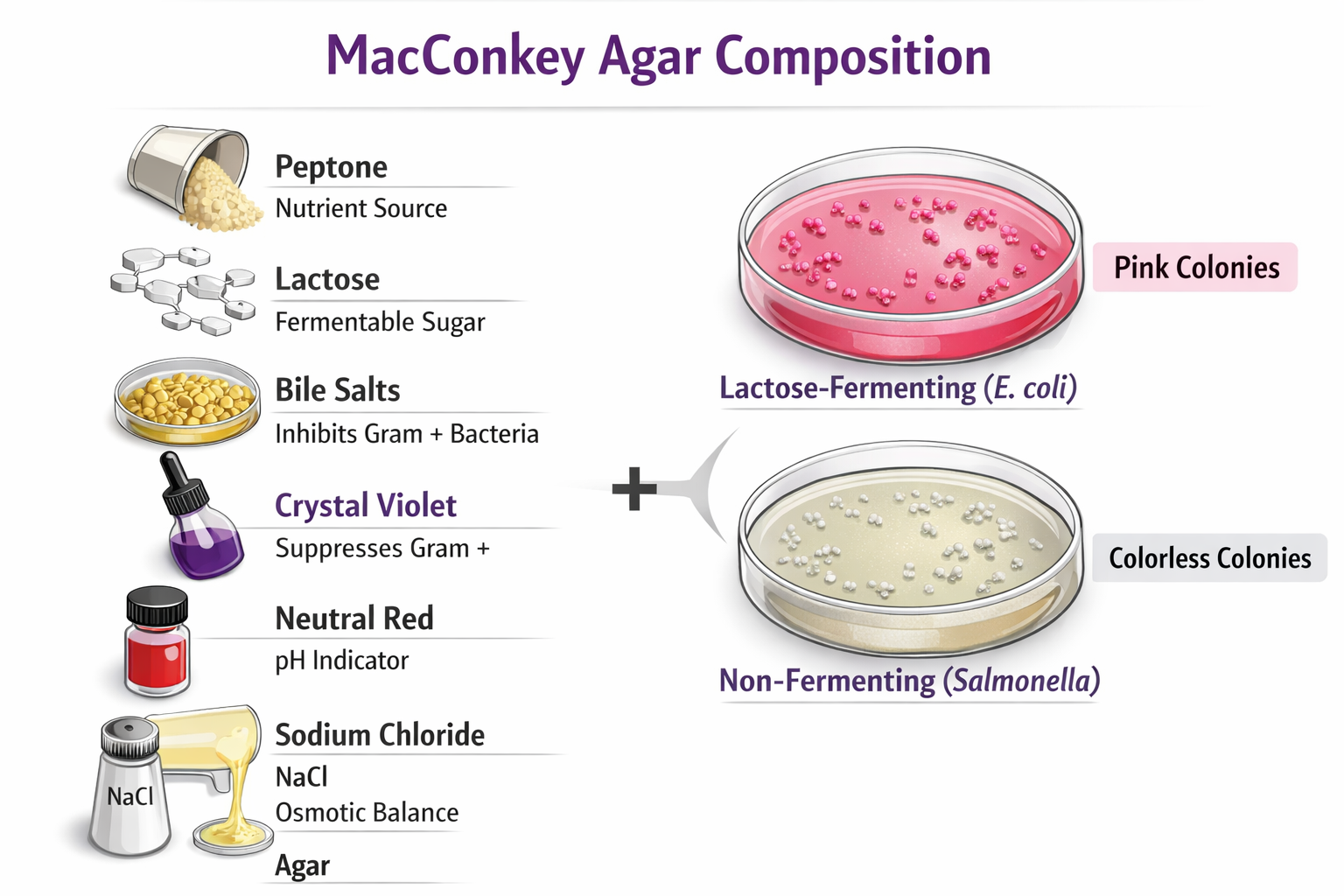
The MacConkey agar composition consists of several key ingredients, each with a specific function:
| Component | Function |
|---|---|
| Peptone | Provides nitrogen, vitamins, and amino acids for bacterial growth |
| Lactose | Fermentable sugar used to differentiate bacteria |
| Bile salts | Inhibit Gram-positive bacteria |
| Crystal violet | Further suppresses Gram-positive organisms |
| Neutral red | pH indicator for lactose fermentation |
| Sodium chloride (NaCl) | Maintains osmotic balance |
| Agar | Solidifying agent |
Role of Each Component in MacConkey Agar
1. Peptone
Peptone serves as the nutrient source, supporting bacterial metabolism and growth.
2. Lactose
Lactose is the key differential component:
- Fermented → produces acid → color change
- Not fermented → no color change
3. Bile Salts and Crystal Violet
These act as selective agents:
- Suppress Gram-positive bacteria
- Allow Gram-negative bacteria to grow
4. Neutral Red
Neutral red is a pH indicator:
- Turns pink/red in acidic conditions
- Remains colorless in neutral conditions
5. Sodium Chloride
Maintains proper osmotic pressure, ensuring cell stability.
6. Agar
Provides a solid surface for colony formation.
How MacConkey Agar Works
The effectiveness of MacConkey agar lies in its dual function:
Selective Action
- Bile salts + crystal violet inhibit unwanted bacteria
- Only Gram-negative bacteria grow efficiently
Differential Action
- Lactose fermenters → pink/red colonies
- Non-fermenters → colorless colonies
Interpretation of Results
| Bacteria Type | Colony Appearance |
|---|---|
| Lactose fermenters (e.g., E. coli) | Pink to red colonies |
| Non-lactose fermenters (e.g., Salmonella) | Colorless or pale colonies |
This makes MacConkey agar essential for clinical diagnostics and pathogen detection.
Applications of MacConkey Agar
MacConkey agar is widely used in:
- Clinical microbiology labs
- Water quality testing
- Food safety analysis
- Pharmaceutical quality control
It plays a key role in detecting enteric pathogens.
Advantages of MacConkey Agar
- Selective for Gram-negative bacteria
- Easy differentiation of lactose fermenters
- Cost-effective and widely available
- Reliable for routine laboratory use
Limitations
- Some Gram-negative bacteria may not grow well
- Overgrowth can mask colony characteristics
- Not suitable for Gram-positive bacteria
Conclusion
Understanding MacConkey agar composition is essential for accurate bacterial identification and laboratory diagnostics. Each component plays a critical role in making this medium both selective and differential.
Whether you are working in clinical microbiology, food safety, or research, mastering this medium will significantly improve your lab results.