
PCR Cycling: Understanding PCR Cycle Number Determination
30th Oct 2026
Molecular Biology | PCR Techniques
PCR Cycling: Understanding PCR Cycle Number Determination
A scientific guide to PCR cycling conditions, DNA amplification, reaction efficiency and selecting the optimal number of amplification cycles.
1. What Is PCR Cycling?
PCR cycling is the repeated process of heating and cooling a reaction mixture to amplify a specific DNA sequence. Polymerase Chain Reaction (PCR) is widely used in molecular biology, genetics, microbiology and medical research to produce millions of copies of a selected DNA fragment.
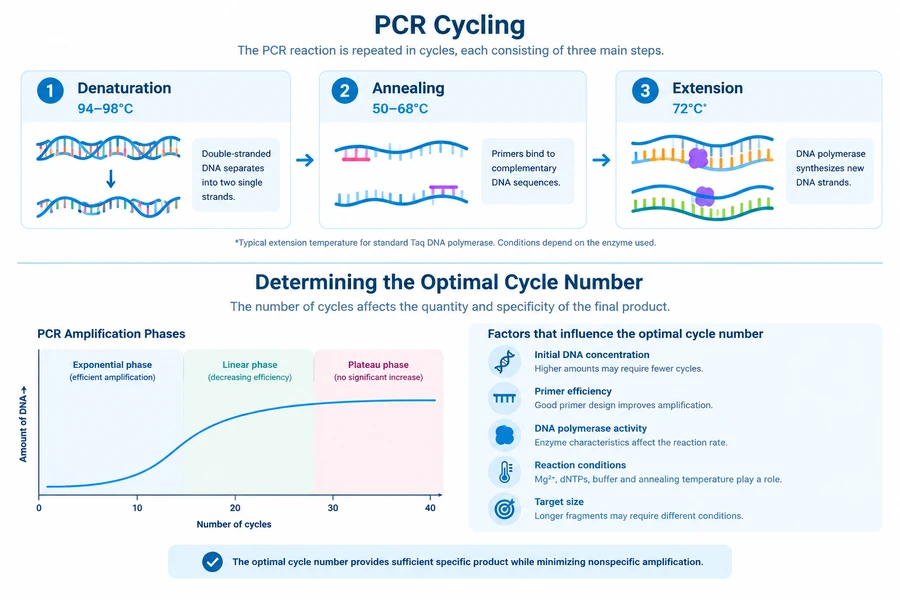
Each PCR cycle consists of three main steps: denaturation, annealing and extension. These steps allow the DNA strands to separate, primers to bind to their complementary sequences and DNA polymerase to synthesize new DNA strands.
The number of cycles is an important parameter because it influences the final quantity and specificity of the amplified DNA product.
2. The Three Main Steps of a PCR Cycle
A standard PCR amplification program includes three repeated temperature steps.
A. Denaturation
During denaturation, the reaction temperature is increased, commonly to approximately 94–98°C. This heat breaks the hydrogen bonds between complementary DNA bases and separates double-stranded DNA into two single strands.
Each single DNA strand serves as a template for the synthesis of a new complementary strand.
B. Annealing
During annealing, the temperature is reduced to allow forward and reverse primers to bind to their complementary target sequences.
The annealing temperature depends mainly on primer melting temperature (Tm), primer sequence and reaction conditions. It is commonly optimized within a range of approximately 50–68°C, although some assays require temperatures outside this range.
Correct annealing conditions help improve amplification specificity and reduce unwanted products.
C. Extension
During extension, DNA polymerase adds nucleotides to the primers and synthesizes new complementary DNA strands.
For many conventional PCR protocols using standard Taq DNA polymerase, extension is performed at approximately 72°C. The required extension time depends on the length of the target DNA fragment and the polymerase characteristics.
At the end of each cycle, newly synthesized DNA molecules can serve as templates in the next amplification cycle.
3. What Is PCR Cycle Number Determination?
PCR cycle number determination is the process of selecting how many amplification cycles are needed to obtain sufficient target DNA for downstream analysis.
Choosing the correct number of cycles is essential for obtaining a detectable PCR product while limiting nonspecific amplification, background products and excessive accumulation of reaction by-products.
The optimal cycle number depends on several experimental factors:
- Initial DNA concentration: Samples containing more starting DNA may require fewer cycles than samples with low DNA concentrations.
- Target DNA length: Longer DNA fragments may require different extension conditions and can influence amplification efficiency.
- Primer efficiency: Primer design and binding efficiency influence how effectively the target sequence is amplified.
- DNA polymerase activity: Polymerase characteristics influence the efficiency and speed of DNA synthesis.
- Reaction conditions: Magnesium concentration, nucleotide availability, buffer composition and annealing temperature can affect amplification performance.
4. How Does the Number of PCR Cycles Affect DNA Amplification?
During the exponential phase, the quantity of DNA increases with each amplification cycle. Under ideal conditions, each DNA molecule produces two copies during one cycle.
The theoretical amplification relationship can be expressed as:
N = N₀ × (1 + E)n
N = final DNA quantity | N₀ = initial DNA quantity | E = amplification efficiency | n = number of cycles
When amplification efficiency is 100%, E equals 1, meaning that the amount of DNA theoretically doubles during each cycle.
For example, starting with one DNA molecule, ideal amplification would theoretically produce:
- After 1 cycle: 2 DNA molecules.
- After 5 cycles: 32 DNA molecules.
- After 10 cycles: 1,024 DNA molecules.
- After 20 cycles: 1,048,576 DNA molecules.
- After 30 cycles: 1,073,741,824 DNA molecules.
These values are theoretical. In real PCR experiments, amplification efficiency is affected by reaction conditions and generally decreases as the reaction progresses.
5. The Three Phases of PCR Amplification
Exponential Phase
During the exponential phase, DNA amplification occurs efficiently. The amount of product increases approximately exponentially because sufficient primers, nucleotides and active DNA polymerase are available.
Linear Phase
As the reaction continues, amplification efficiency begins to decrease. Some reaction components become limited, and the rate of DNA synthesis is reduced.
Plateau Phase
During the plateau phase, DNA amplification slows significantly or stops. This can occur because of nucleotide depletion, reduced polymerase activity, product re-annealing and accumulation of PCR products.
For this reason, collecting endpoint PCR products after excessive cycling may not provide a reliable representation of the original DNA concentration.
6. How to Determine the Optimal PCR Cycle Number
The optimal number of PCR cycles should be determined experimentally according to the target sequence, starting DNA concentration and intended application.
A practical approach for conventional endpoint PCR includes the following steps:
- Prepare the DNA template: Determine the quality and approximate concentration of the starting DNA.
- Optimize primer conditions: Check primer specificity, melting temperature and expected amplicon size.
- Perform a pilot PCR: Test several cycle numbers using the same reaction mixture and thermal conditions.
- Compare amplification products: Analyze the PCR products using agarose gel electrophoresis.
- Evaluate specificity: Identify the cycle number that produces a clear band of the expected size with minimal nonspecific amplification.
- Select the optimal condition: Choose the lowest cycle number that provides sufficient specific product for the intended downstream application.
For example, a pilot experiment may compare 20, 25, 30, 35 and 40 cycles. These are illustrative test points, not universal recommended cycle numbers. The final selection should be based on the observed amplification results.
7. PCR Cycle Number in Conventional PCR and qPCR
Cycle number determination differs between conventional endpoint PCR and quantitative real-time PCR (qPCR).
Conventional PCR
In conventional PCR, the amplified DNA is generally analyzed at the end of the reaction using agarose gel electrophoresis. The cycle number is selected to obtain sufficient target DNA while avoiding excessive amplification and nonspecific products.
Many conventional PCR protocols use approximately 25–35 cycles, but the optimal number depends on the specific assay and starting material.
Quantitative Real-Time PCR (qPCR)
In qPCR, DNA amplification is monitored during each cycle using fluorescent dyes or sequence-specific probes. The amplification curve provides information about the accumulation of PCR products in real time.
The quantification cycle (Cq), also commonly called Ct, represents the cycle at which the fluorescence signal crosses a defined threshold above the background.
Unlike conventional PCR, qPCR generally uses a predefined cycling program that is validated to detect the expected target concentration range. Quantification relies on measurements within the exponential amplification phase rather than the final plateau.
8. Why Is Correct PCR Cycle Number Important?
Choosing an appropriate cycle number improves the reliability and quality of PCR experiments.
- Improved specificity: Helps reduce nonspecific amplification and unwanted DNA bands.
- Better product quality: Supports the production of the expected DNA fragment.
- Reduced amplification bias: Helps limit the preferential amplification of certain DNA templates.
- Reliable downstream analysis: Provides suitable DNA products for sequencing, cloning and other molecular biology applications.
- Reproducibility: Consistent cycling conditions improve comparison between experimental samples.
9. Common PCR Cycling Problems and Troubleshooting
Incorrect cycling conditions or cycle numbers can affect the quality of DNA amplification. Common problems include:
No PCR Product
Possible causes include poor DNA template quality, unsuitable annealing temperature, incorrect primer design or insufficient amplification. Check the reaction components and optimize the cycling conditions.
Nonspecific Bands
Multiple DNA bands may indicate nonspecific primer binding or unsuitable annealing conditions. A gradient PCR experiment can help identify a more appropriate annealing temperature.
Smearing on Agarose Gel
Smearing can result from nonspecific amplification, excessive template DNA, degraded DNA or inappropriate PCR conditions. Review the template quality and optimize the reaction.
Weak Amplification
Weak bands may be associated with low template concentration, inefficient primers or insufficient amplification. Evaluate the reaction conditions before increasing the number of cycles.
10. Conclusion
PCR cycling is a fundamental process in molecular biology that enables the selective amplification of DNA sequences through repeated denaturation, annealing and extension steps.
Determining the appropriate PCR cycle number is essential for obtaining sufficient and specific amplification products. By considering initial DNA concentration, primer efficiency, polymerase activity and amplification phases, researchers can optimize PCR conditions and improve experimental reproducibility.
11. Scientific References
- Bustin SA, Benes V, Garson JA, et al. (2009). The MIQE Guidelines: Minimum Information for Publication of Quantitative Real-Time PCR Experiments. Clinical Chemistry, 55(4), 611–622.
https://doi.org/10.1373/clinchem.2008.112797 - Ruijter JM, Ramakers C, Hoogaars WMH, et al. (2009). Amplification efficiency: linking baseline and bias in the analysis of quantitative PCR data. Nucleic Acids Research, 37(6), e45.
https://doi.org/10.1093/nar/gkp045 - Svec D, Tichopad A, Novosadova V, Pfaffl MW, Kubista M. (2015). How good is a PCR efficiency estimate: Recommendations for precise and robust qPCR efficiency assessments. Biomolecular Detection and Quantification, 3, 9–16.
https://doi.org/10.1016/j.bdq.2015.01.005 - Bustin SA, et al. (2025). MIQE 2.0: Revision of the Minimum Information for Publication of Quantitative Real-Time PCR Experiments Guidelines. Clinical Chemistry.
https://doi.org/10.1093/clinchem/hvaf043
Scientific Educational Content | Molecular Biology | PCR Techniques | DNA Amplification