
Sanger Sequencing: Principle, Steps, Applications, Diagram
10th Apr 2026
Sanger Sequencing: Principle, Steps, Applications, Diagram
What is Sanger Sequencing?
Sanger sequencing is a method used to determine the exact sequence of DNA. It is also called the chain termination method because it stops DNA synthesis at specific points.
It is one of the most accurate DNA sequencing techniques used in laboratories.
Sanger Sequencing Principle
The principle of Sanger sequencing is based on:
- DNA replication
- Use of normal nucleotides (dNTPs)
- Use of chain-terminating nucleotides (ddNTPs)
When a ddNTP is added, DNA synthesis stops immediately.
This creates DNA fragments of different lengths, which helps determine the DNA sequence.
Components of Sanger Sequencing
- DNA template
- Primer
- DNA polymerase
- dNTPs (normal bases)
- ddNTPs (terminating bases)
- Buffer
Steps of Sanger Sequencing (Step-by-Step)
1. Denaturation
DNA is heated → strands separate
2. Primer Binding
Primer attaches to DNA template
3. DNA Synthesis
DNA polymerase adds nucleotides
4. Chain Termination
ddNTP stops DNA growth
5. Fragment Formation
Different DNA lengths are produced
6. Separation
Fragments separated by electrophoresis
7. Sequence Reading
DNA sequence is identified
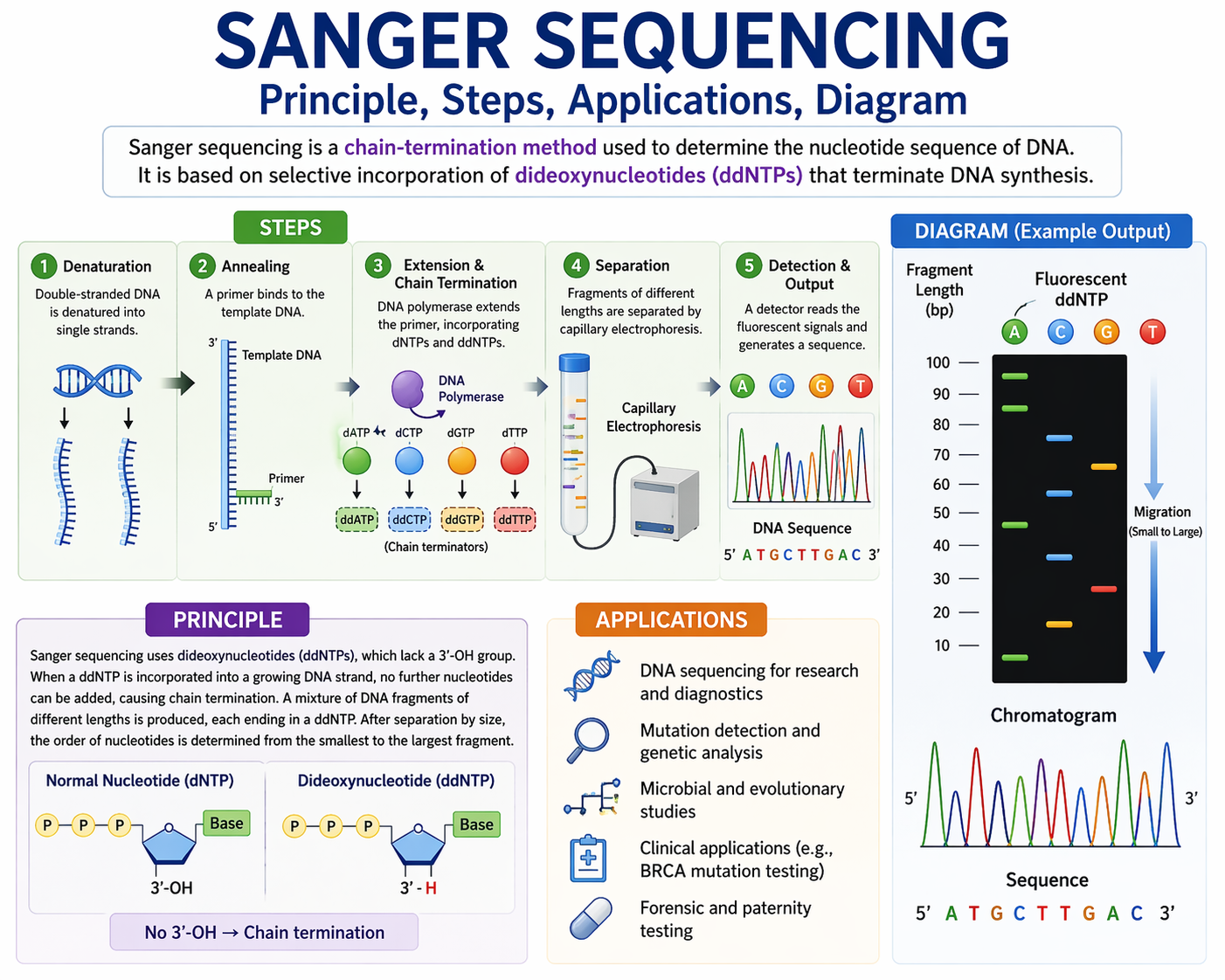
Sanger Sequencing Diagram
A typical diagram shows:
- DNA template
- Primer
- DNA polymerase
- ddNTP incorporation
- Terminated fragments
- Gel electrophoresis results
This visual helps understand how DNA fragments are analyzed.
Applications of Sanger Sequencing
- DNA sequencing
- Mutation detection
- Genetic disease diagnosis
- PCR product analysis
- Plasmid verification
- Microbial identification
Advantages of Sanger Sequencing
- Very high accuracy
- Reliable results
- Easy to interpret
- Ideal for small DNA fragments
Limitations
- Slow for large DNA
- Expensive per sample
- Low throughput
Why is Sanger Sequencing Still Used?
Even with modern sequencing methods, Sanger sequencing is still used because:
It is the gold standard for validation
It provides high-quality results
Quick Summary
Sanger sequencing is a DNA sequencing method based on chain termination using ddNTPs, producing DNA fragments of different lengths that are analyzed to determine the DNA sequence.
FAQ
What is Sanger sequencing used for?
Sanger sequencing is used for DNA sequencing, mutation detection, and genetic analysis.
Why is it called chain termination method?
Because ddNTPs stop DNA synthesis during replication.
Is Sanger sequencing accurate?
Yes, it is one of the most accurate sequencing methods.
What is the read length of Sanger sequencing?
Around 500–1000 base pairs.